
Brighton SEO April 2026 – The One Where We Learnt a Lot About AI Shopping
Agentic Commerce, AI Search and What E-Commerce Brands Need to Do About It
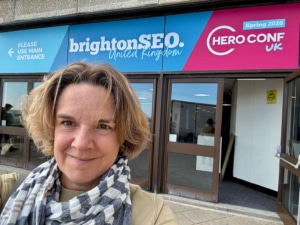
I’ve been to every Brighton SEO event I could possibly get to since 2017, and one thing I love about it is the shopping. I live in the middle of nowhere. Since January’s big storm, we can’t even get Amazon delivered in less than a week. Yes, I love learning lots about search marketing, but I also bloody love a wander around the shops in Brighton. However, it seems I am in a small minority. Almost every talk I went to this April, whether it was billed as e-commerce, SEO, advertising, measurement or AI, came back to the same point. AI agents are increasingly doing the shopping, and our human customers seem to be more than happy to let them get on with it.
For e-commerce brands, this changes a lot. Or, depending on how you look at it, it changes very little. Either way, there’s plenty to be getting on with.
I went to as many of the e-commerce and AI optimisation talks as I could over the two days. In this write-up, I have attempted to pull together observations from all the talks from the agentic commerce threads. I also spent a lot of time hearing from speakers on measurement, tracking and reporting, which I’ll be implementing into my own practice and may write another post on later. For now though, here’s what e-commerce marketers need to know about AI as the buyer.
These highlights are in my own words, so may not perfectly reflect what each speaker said. If I have mentioned you and you didn’t mean quite what I’ve said, or I have any facts wrong then do let me know. If you’re reading this and would like to find out more direct from the speakers themselves, then I have included LinkedIn links to as many of them as I could find.
Agents are the New Shoppers
If your e-commerce strategy is still built around getting humans to your site, it’s time to revisit it. According to Dr Greg Fletcher of Ocula, 45% of users already use AI for at least part of their buying journey, and the infrastructure to take that further is already in place. Two protocols are emerging for agentic shopping: the Agentic Commerce Protocol (ACP) from OpenAI and Stripe, and the Universal Commerce Protocol (UCP) from Google and Shopify. ChatGPT has scaled back its instant checkout pilot for now, but the discovery side of ACP is still being built. Perplexity has rolled out Instant Buy in the US powered by PayPal. The plumbing is being put in. The taps aren’t quite turned on yet…
Wendi Sturgis, of Yext (she introduced herself saying she is so old that she ran Yahoo… she is about the same age as me!), put it as well as anyone: “Your brand is no longer competing for clicks, you’re competing to be the source AI trusts.” Adidas, she pointed out, is already seeing a meaningful shift, with 41% of its referrals coming from LLMs.
Callum Lockwood of Sistrix, who spoke about winners in women’s fashion, called agentic search “the next shift we need to be ready for”. With ACP and UCP still rolling out, we should already be planning for a world in which the customer never visits our site at all.
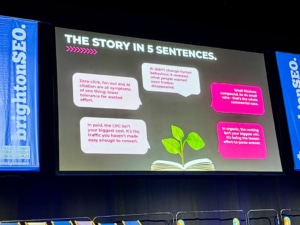
Does this change in behaviour actually matter? Prince Enwere of Reflect Digital, gave a thoughtful talk on the psychology behind these shifts. 60% of Google searches now end without a click, 50% trigger an AI Overview, and Google search in the UK is down 9% year-on-year. Is this because we all have shorter attention spans? Apparently not, as we are still happily binging hours and hours of video content every day. We just have a lower tolerance for wasted time. “Zero click isn’t an SEO problem,” Prince said, “it is a tolerance problem.” People come to search with their decision already mostly made, and they expect AI to confirm it. The click is no longer the primary moment of value. The AI mention is.
What AI Agents Look For On Your Product Pages
The question, then, is what does an AI agent actually use to decide which products to suggest? Greg Fletcher offered the clearest framework I heard. Agents lean on a few specific signals: product highlights (a kind of fact sheet about each product), Q&A pairs (“Is the fit true to size?”, “What occasions is this suitable for?”), competitive differentiators (the LLM has to pick one product from many, so what are you giving it to make yours stand out?), and use-case and intent tags. A search like “suggest a comfortable long dress that will look stylish and be easy to pack” needs you to have stated who, why and when the dress is for, not just what it is.
The takeaway is uncomfortable for anyone running a site with thin product pages. Every SKU now needs an enriched title, ten to thirty structured attributes, use-case tags, compatibility data, multilingual variants (if you are selling internationally) and channel-specific formatting. As Greg cheerfully put it, this is a big job for humans but luckily “an excellent problem for AI agents to deal with.”
Malte Landwehr of Peec AI’s talk on how ChatGPT shops added some useful detail. ChatGPT mainly scrapes Google Shopping for product results, but it also pulls from reviews, listicles and advertorials. He mentioned a brilliant little experiment, where someone invented a non-existent matcha powder and wrote a few listicles and advertorials about it. It duly appeared as a recommendation in ChatGPT. So yes, self-promotion listicles annoyingly do work, and some smart SEO agencies are already doing very nicely out of that! Malte also explained how ChatGPT generates fan-out queries – the sub-queries it adds to the original prompt – such as “review”, “vs”, and “comparison”. Look at what fan-out terms come back for your category prompts and put those terms into your product attributes (for example: premium, heavyweight, durable, lightweight, or whatever applies).
Theo Roberts from EcomOne gave one of the clearest, most practical talks of the conference. His ten takeaways for optimising for AI search are sitting in my notes as a near-perfect e-commerce checklist, but the headline point was: “optimise for passages not pages – answer each question in a concise and clear way.” His example resonated. If someone asks how to measure their waist for men’s trousers, the answer to that question needs to be sitting on the trousers category page. Not in a hidden help page. Put it right there, with the product info, where the AI, and humans can find it.
Gintare Rimolaityte from Trendos reinforced what was becoming a clear theme: your own website is still the most important source AI uses to cite and recommend you. UK AI tools typically give between two and seven sources per answer, and onsite SEO is consistently doing the heavy lifting, whatever industry you are working in.
Where AI Looks Beyond Your Website
Onsite content is often the main source for an AI tool, but is far from the only place it looks. Wendi Sturgis offered the most useful breakdown of where AI actually pulls its citations from: c.48% from websites (full control), c.44% from listicles (some control), c.5% from reviews and social (which you have some control over, as you can reply to them), and c.4% from news and forums (often no control). About 91% of what AI cites, in other words, comes from places brands can influence. A useful framework to understand.
Chris Walsh from IDHL reinforced this, telling us that of the citations that LLMs pull, 45% is owned or earned media. The rest is ads or advertorial. Which is to say, that some of those AI answers we think of as organic, are in fact substantially pay-to-play. Chris warned us not to forget that “Brand trust isn’t built only where Google and LLMs look, it’s built where your audience is,” so keep your eyes open to that too!
So, which offsite places matter? Ethan Smith, CEO of Graphite, opened the conference with a useful list. Earned offsite content – your own YouTube channel especially (and “the less entertaining your product is, the more important it is to make videos about it”), LinkedIn, social UGC on Reddit and Quora, affiliates and external blogs. Reddit, he warned, is genuinely hard to get right and you can’t fake your way in. But you can absolutely build a presence on the rest. He also reminded us that the same sites tend to show up again and again in AI citations, so once you’ve identified the citation engines for your category, doubling down on them pays off.
For e-commerce specifically, Callum Lockwood listed the actual sites AI search relies on for women’s fashion queries. These included: YouTube, Google’s own AI feed, Reddit, WhoWhatWear, Instagram, Facebook, TikTok, Quora, Forbes, Vogue and InStyle. Reviews, “best of” listicles and comparison content all played a role. It’s worth knowing that Future PLC owns both WhoWhatWear and InStyle, which gives you a much shorter list of doors to knock on than you might have thought. The other point Callum made that stuck with me was that AI search rewards brands that do one thing really well. Patagonia for down jackets, The Shirt Company, Simply Swim. Specialism beats trying to be good at everything.
The Fundamentals Haven’t Really Changed (and That’s the Good News)
As I sat through these talks, I realised with some relief that actually, not much has changed. I have been pushing clients to do these things for years. Brighton SEO speakers have been covering these recommendations in almost every talk I’ve seen in coming up for a decade of attendance.
Theo Roberts’ ten-point checklist for AI search reads almost identically to the SEO advice we were giving in 2018. Build brand and topical authority with a clean Main Category to Sub Category to Supporting Articles structure. Make sure your site is crawlable. Implement schema. Add new page types like glossaries defining your industry’s key terms. Include your products in listicle-style “Top 10s” and have a properly fleshed-out About Us page that answers who, what, why, when and how you are. Build a social-proof layer of reviews, testimonials, UGC, and “as seen in” press mentions.
Copy specialist Alice Rowan came at the same fundamentals from a content angle. E-E-A-T is still the framework. Authority is built through backlinks, citations and social proof. Trust is built through case studies, clear copy, easy navigation, scannable information and a consistent tone. None of that is new. What was new was her bluntness about priorities: “Prioritise Conversion over SEO on every piece of content – copy, structure and usability. More organic traffic means f*ck all if people don’t understand what you’re doing when they get to your site.” She is right. We are increasingly bringing fewer, better-qualified visitors to sites, and the cost of failing them on arrival is higher than it has ever been. While we’re at it, she gave a useful nudge to drop the w*nky generic anchor text (“Read More”, “Click Here”, “Learn More”) and use keyword-rich descriptive anchors instead. Obvious, perhaps, but still very common.
Nick Beck of Tug offered a useful diagnostic framework for finding the gaps in how LLMs see your brand. To be recommended by AI you need to be Understandable (clear identity, purpose and offerings), Credible (E-E-A-T plus external validation) and Accurate (a consistent entity across your site, socials, reviews and the wider ecosystem). His suggested process was to: 1) Interrogate the LLM (“how does your understanding of our brand differ from our website?”, “why do you not recommend us compared to X?”), 2) Diagnose what the gaps are, 3) Map the barriers (knowledge, entity, trust, context) and 4) Fix the signals. He gave a nice example of Legoland Florida, where the LLM thought it was only a one-day experience. Legoland’s team responded by publishing more multi-day content and visibility soon shifted to recommend it for longer stays.
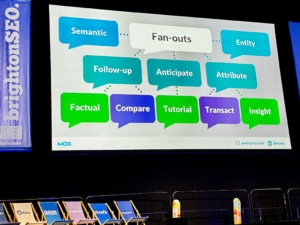
Dr Pete Meyers from Moz closed the conference with a keynote that nicely tied keyword research into the AI age, and made me desperate for a cup of tea. His core argument was, of course, that we already know how to do this. Search has been moving from short keywords to long, natural-language queries for at least ten years. The “long tail” is now an “infinite tail”, but the techniques remain the same. He laid out the types of fan-out queries you can optimise for (entity, semantic, follow-ups, anticipated follow-ups, attributes, factual, compare, tutorial, transact and insight), and these are all directly actionable for an e-commerce site. And all using examples relating to making the perfect brew!
Maybe my favourite takeaway, though, came from Judith Lewis, someone else who has been around since I built my first site on Geocities. Judith pointed out that AI optimisation is such a buzz term right now that you can use it to finally push through the SEO recommendations you’ve been making for years. Owners and those who hold the purse strings get excited about AEO when SEO leaves them cold, and the underlying changes are largely the same. As she put it, “We’ve been struggling with all this for years and now we can push it again and people will do it this time because IT’S FOR AI!”
This made me laugh, and it’s also true. Worth remembering if you’ve found it hard to persuade anyone to pay for SEO changes in the past!
A Unified Message – Shopping Online is Changing
There is no doubt that this season’s conference had a unified message. AI is changing how people, and increasingly the agents acting for them, discover and choose products. The fundamentals of being findable, useful, trustworthy and well-structured haven’t really changed. The urgency around this has. For e-commerce brands, the work is mostly obvious: add rich product and category data, FAQs in the right places, clear category structures, social proof, and info AI tools can definitely read. None of it is glamorous. None of it is new. All of it matters.
I’m planning to follow this up with at least one more blog covering the measurement, tracking and reporting talks, and possibly some ideas to share from the excellent Conversion Rate Optimisation training day I attended on the Wednesday. For now, thanks as always to everyone involved with Brighton SEO and to the speakers for giving up their time and sharing their ideas so generously. The next conference is in October. I’m looking forward to it already. And the shopping!


Our Boasting Letter 2024
Advertising, SEO, Uncategorised, Website DevelopmentOur 2024 – Website Rebuilds, Google, Microsoft and Meta Ads Through Tough Times, Educating Marketers and CFOS… and Winning Dog Shows.
Case Study – 3 New Websites for St Austell Companies
Website DevelopmentA Case Study of updating, rebuilding and migrating 3 WordPress sites for St Austell businesses.
Brighton SEO Report October 2024
Advertising, How To, SEOSamphire Marketing’s update from Brighton SEO October 2024 – on E Commerce SEO, tracking and omnichannel marketing.